

You sat down to plan your vegetable garden. You had your companion planting chart, your rotation circle, your bed layout — and somewhere around bed three, it stopped making sense.
If the same plant family ends up in more than one bed, the rotation breaks. But if you keep each bed to one family, where do the companions go? And in a Mediterranean climate, where most beds carry two crops a year, which one counts for rotation?
This is not a beginner mistake. It is a real planning problem, and most gardening advice does not address it. This post gives you three rules that make companion planting and crop rotation work together.
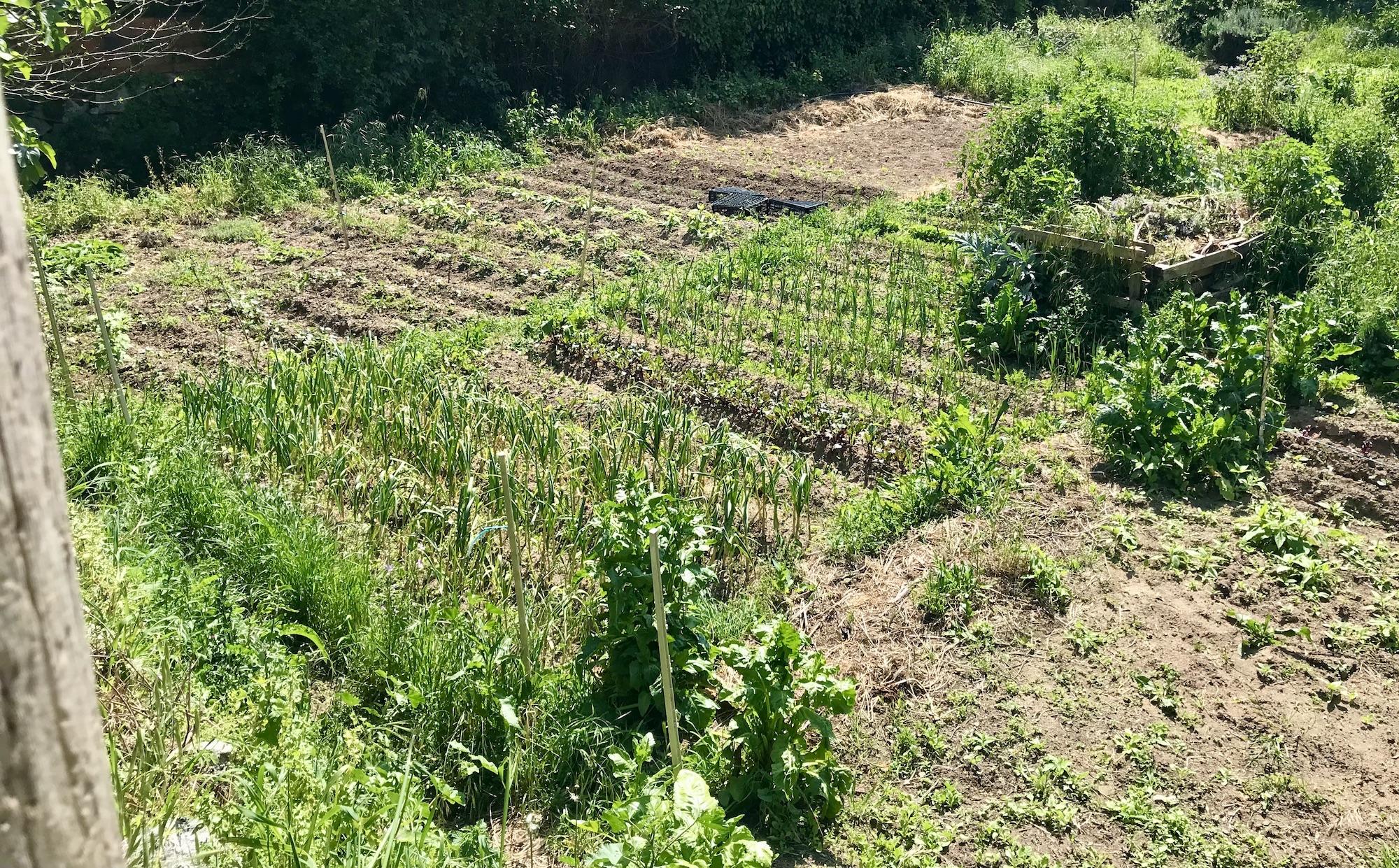
Why Companion Planting and Crop Rotation Seem to Conflict
Companion planting encourages you to mix plant families in the same bed. The onion family alongside the cabbage family, the legume family before the heavy feeders, basil between the tomatoes — that is the whole point. Crop rotation asks you to keep families separate and move them around year by year. When you try to do both at once, the logic seems to fall apart.
This comes up in every group that works through the planning exercise in the Companion Planting Made Simple course here at Monchique Homestead. Students leave with the question unanswered more often than not. This post is the answer they were promised.
The Warm Dry Climate Adds Another Layer
There is an extra complication for gardeners in a warm dry climate. Whether you garden in southern Portugal, California, southwestern Australia, South Africa, or central Chile, your growing season works differently from the northern European model that most rotation advice is based on.
In a Mediterranean climate you have two growing seasons. Most beds carry two main crops across the year. Both crops take from the soil. Both need to be considered when you plan next year's rotation. This is a problem specific to warm dry climates that rarely appears in mainstream gardening guides.
Three Rules That Solve Three Problems
The tension between companion planting and crop rotation comes down to three connected problems. Most gardeners run into all three in the same planning session.
The first problem is that the rotation circle breaks before it starts — because beds get filled with whatever looks good, and the same family ends up in more than one bed.
The second problem is that fixing the rotation seems to make companion planting impossible — if each bed belongs to one family, where do the companions go?
The third problem is timing — even a well-designed rotation falls apart if the incoming bed is not free when it needs to be.
Each of these has a clear answer:
Rule 1 solves the broken rotation: fix the circle before you fill any bed.
Rule 2 solves the companion planting problem: the bed is a fixed unit and travels as a whole.
Rule 3 solves the timing problem: check what the bed needs to be free of, and whether it will actually be free in time.
Rule 1: Fix the Rotation Circle Before You Fill Any Bed
Why Most Rotation Plans Break Before They Start
Most gardeners fill their beds with the vegetables they want, then try to build a rotation around what they have. This is where it goes wrong.
When you fill beds freely, the same plant family ends up in more than one bed. When you then try to rotate, that family keeps meeting itself the following year. The rotation is broken before it starts.
How to Set Up the Rotation Circle
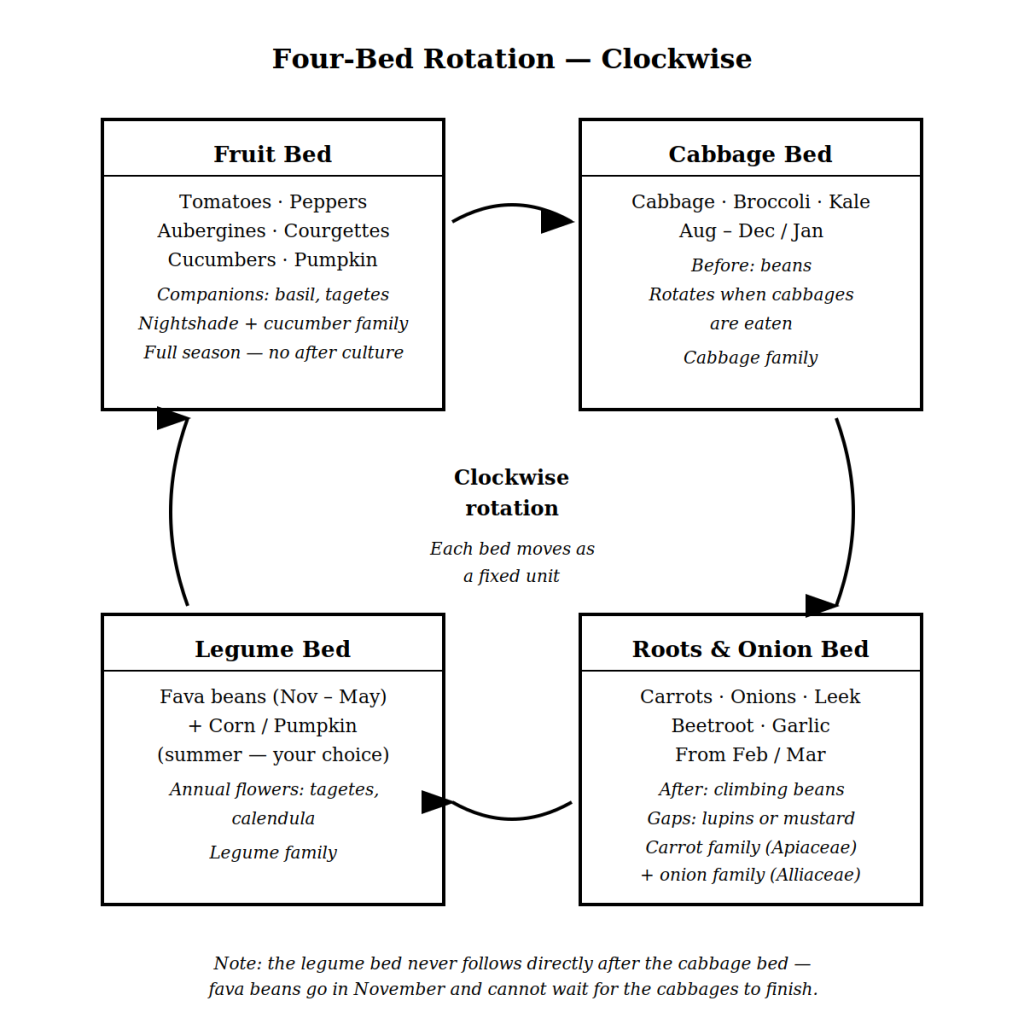
Assign one main family to each bed before you write in a single vegetable. Draw the four boxes with arrows first. Check that the circle works. Only then fill in the rest.
The two families that must never follow themselves are the nightshade family and the cabbage family — so no nightshade family after nightshade family, and no cabbage family after cabbage family. These carry the highest risk of disease building up in the soil — clubroot for the cabbage family, blight for the nightshade family. All other families are much more forgiving, though it is still worth keeping them moving.
Rule 2: The Bed Is a Fixed Unit — It Travels as a Whole
Companions Are Passengers
Each bed is a fixed combination of main crops, before cultures, after cultures, companions, and annual flowers. You design it once, and then the whole unit rotates together each year. Nothing inside the bed changes. The combination travels intact.
The main family — or families — names the bed for rotation. Everything else is a passenger. A few plants from the onion family (Alliaceae) alongside a cabbage bed do not make it an onion bed. When that bed rotates next year, it moves as a cabbage bed. The onions come along for the ride.
What This Means in Practice
You track the main family when you draw the rotation circle — not every plant in the bed. This is what resolves the tension between companion planting and crop rotation. Companions work inside the bed. Rotation works across the whole garden, across years. The two do not interfere with each other.
Rule 3: Check What the Bed Needs to Be Free Of
Before and After Cultures Travel With the Bed
When a bed unit rotates into a new position, the before culture arrives with it. The after culture arrives with it too. Before and after cultures are easier to adjust than main crops. So the process is simple: fix the rotation circle using the main families first, then check the before and after cultures and adjust where needed.
The Fava Bean Timing Problem
There is a timing problem in a warm dry climate that is worth naming clearly. Fava beans go into the ground in November. If the bed they are moving into is not yet clear — because the cabbages in that bed are still being harvested — there is no room for them.
This means the legume bed can never follow directly after the cabbage bed in the rotation circle. The rotation does not move on a set date. It moves when the bed is cleared — when the cabbages are eaten. That is why checking the timing of each move matters as much as checking the families.
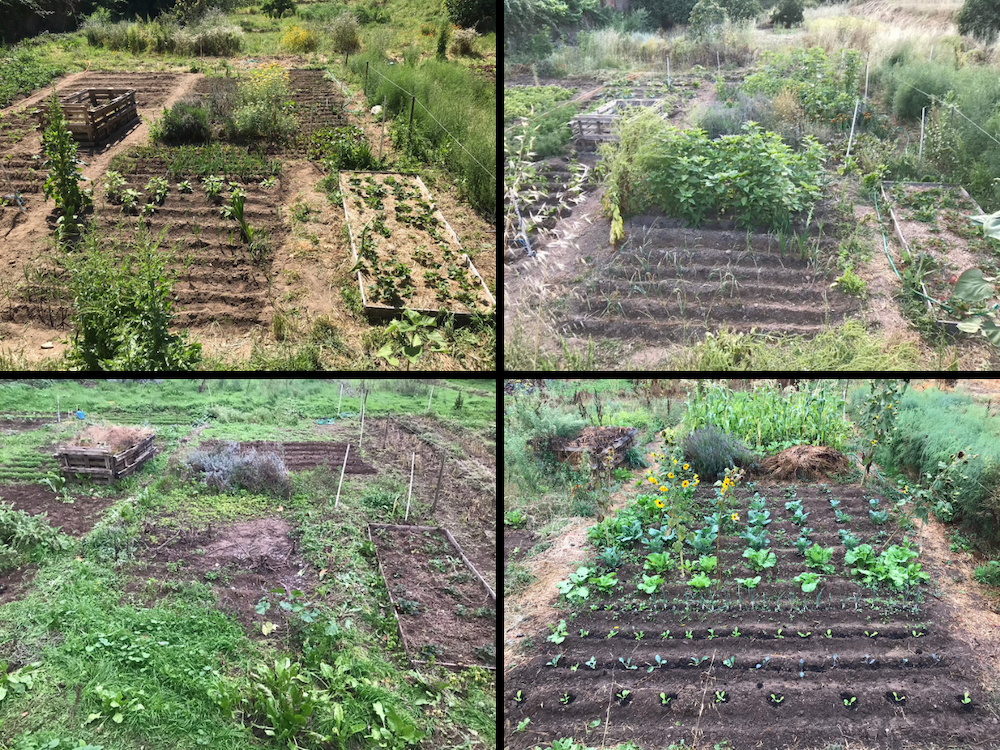
A Worked Example: Four Fixed Bed Units
Here is what companion planting and crop rotation look like in practice at Monchique Homestead. Each bed is a fixed unit, designed once and rotated as a whole. The beds are described in rotation order — the same order as the diagram above.
The Fruit Bed: Nightshade and Cucumber Family Together
This bed holds the nightshade family and the cucumber family together for the full season. Tomatoes, peppers, and aubergines grow alongside courgettes, cucumbers, and pumpkin. Companions — basil, tagetes — are planted between them and stay in the same positions year after year as part of the unit.
Because this bed is full for the entire season, there is no after culture and no room for anything else.
The Cabbage Bed: Legume Family Before, Cabbage Family After
The legume family goes in first as a before culture, clearing the ground in time for the cabbage family to follow from around August. Cabbage, broccoli, and kale then fill the bed through to December or January.
The rotation does not move until the cabbages are eaten. When the bed is clear, the next unit moves in. This bed also has a fixed rule in the rotation: the legume bed cannot follow directly after it, because fava beans cannot wait for the cabbage family to finish.
The Roots and Onion Bed: Early Start, Long Season
Carrots, onions, leek, beetroot, and garlic all go in together from February or March. There is no before culture — these crops go in early enough that nothing needs to come first. Gaps are filled with green manure: lupins work from February through to November, and mustard grows at almost any time of year.
After the roots are harvested, climbing beans go in as an after culture, putting nitrogen back into soil that has worked hard all season. Bush beans, endive, or lamb's lettuce are also good options depending on timing.
The Legume Bed: Nitrogen First
Fava beans go in during November as the first main crop, adding nitrogen to the soil through the winter. What follows in summer is your own design decision — corn is a common choice, and pumpkin can go alongside it. Annual flowers, tagetes and calendula, travel with this unit as part of the fixed combination.
This is the most flexible of the four beds. The legume family gives the bed its name in the rotation. Whatever you choose for the summer season becomes part of the fixed unit once designed.
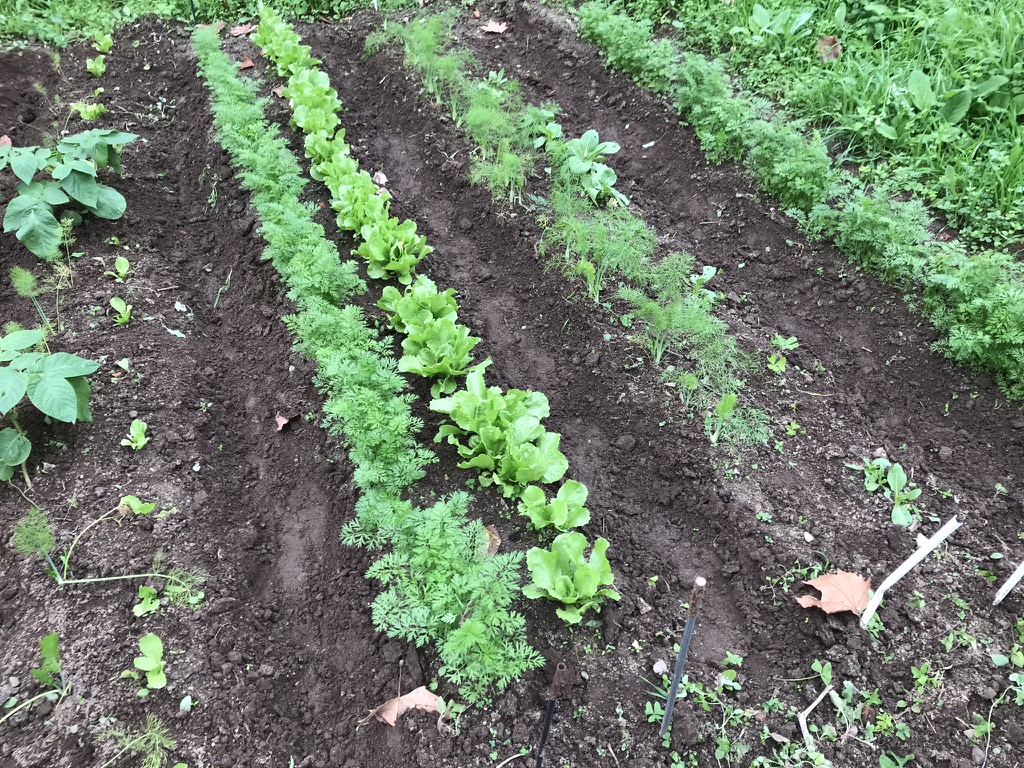
Timing: The Step That Most First Plans Get Wrong
Even a well-designed rotation circle can break down when the timing does not work out. A bed still full of cabbages in spring has no room for the next unit, even if the rotation says it should move there. The families were right but the timing was not.
How to Check Your Transitions
When you draw your rotation circle, check not just which family follows which — check whether each bed will actually be free in time. In a warm dry climate with two growing seasons, this is the step that most often needs adjusting. Your first plan will almost certainly need a change or two before the timing works across all four beds.
This is normal. It is part of designing the garden, not a sign that something is wrong.
Companion Planting and Crop Rotation Work Together — Once You Have a System
The most important families to protect are the nightshade family and the cabbage family. For everything else, a rotation that keeps families moving and avoids obvious repetition gives your soil most of the benefit.
If one year the timing slips because a bed was not clear in time, that is not a failure. Note it and adjust next year's plan. The goal is a rotation that gets better over time, not one that is perfect from the start.
Gardening in a warm dry Mediterranean climate means two seasons, variable harvests, and beds that are rarely fully empty. Directional is good enough — and with these three rules, that is entirely within reach.
Want to Learn More About Companion Planting?
The Companion Planting Made Simple course at Monchique Homestead takes you through the full planning process — from plant families and companion combinations to designing your own four-bed rotation with Oppel timelines. It is a hands-on two-day course on a working warm dry climate homestead in the Serra de Monchique, Portugal.
Find out more and book your place here.